
This article was co-written by Natalia Rachman and Arin Klein.
When Switzerland won their first Olympic medal in women’s hockey in 2014, they did so with the youngest roster on average of the entire field. They also did so with a leading point total of just three in six games, shared by three players, one being a then-15-year-old Alina Müller. Not exactly a recipe for a podium finish—unless, of course, you have the goaltending performance of Florence Schelling behind you.
Schelling deservedly was named to the tournament all-star team, as well as receiving MVP and Best Goaltender nods for her exploits. She made 252 saves over the course of the tournament, 82 more than her next closest competition in Finland’s Noora Räty. She made 28 saves in the bronze medal game as Switzerland took down Sweden despite being outshot.
Fast-forward to January 2026, when another Swiss netminder was given Best Goaltender and all-star honours at the U18 Women’s World Championship. Sixteen-year-old Norina Schrupkowski was the heart and soul of Switzerland’s team, putting up a .937 save percentage (SV%) and, like Schelling, a tournament-high save total of 149 despite bowing out in the quarterfinal.
Switzerland’s goaltending competed with the best of the best in the 2010s, thanks to Schelling, and looks to be in good hands for the 2030s with Schrupkowski. That leaves us with the 2020s, which began with a stumble in the nation’s first Olympic appearance without their MVP in goal.
Life without Schelling
At Beijing 2022, Switzerland allowed 43 goals, had a goals-against average (GAA) of 6.14 in seven games, and finished dead-last in save percentage with an .873. Compared to Schelling’s lifetime 2.86 and .920, respectively, at the Olympics, it was a striking step backwards. But it was a feeling-out process for the young goaltending tandem of Andrea Brändli and Saskia Maurer. Four years later, they’d take the world by storm.
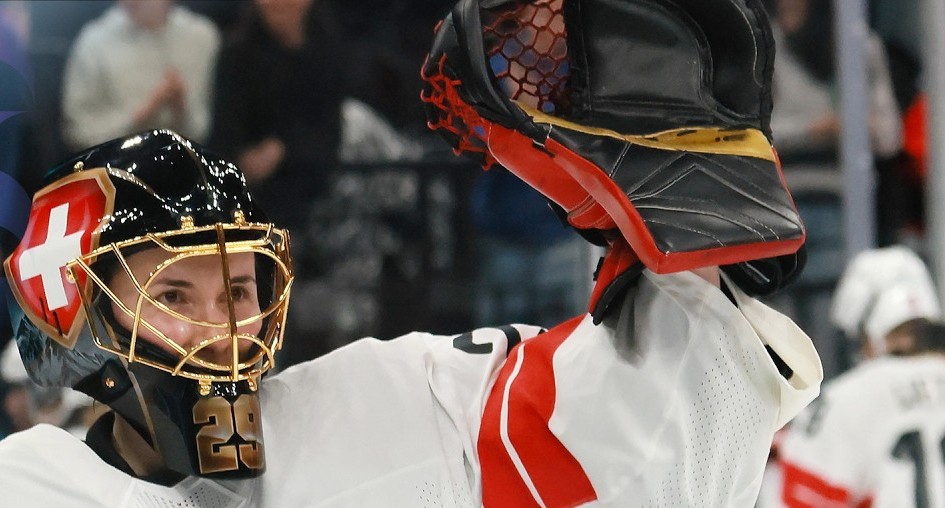
At the 2026 Olympics, the two goaltenders allowed only 18 goals and had a combined GAA of 2.50 across seven games. Switzerland finished third in team SV%, behind only the USA and Sweden. Brändli’s and Maurer’s performances powered Switzerland to the podium for the first time in 12 years.
Switzerland’s women’s hockey program has made huge strides in the last four years in all areas of the ice. But in Milan, the difference in net particularly stood out. They proved that 2022 was just a blip in their longtime legacy of elite goaltending. Switzerland’s current tandem may be unfamiliar to fans who are newer to women’s hockey or to women’s hockey outside of North America.
Who are Brändli and Maurer, and what should you know about them?
Andrea Brändli
Age: 28
Hometown: Wald, Switzerland

Junior and senior national team debuts
Andrea Brändli was named the best goaltender at the 2014 U18 Women’s World Championship (Division 1A). For the senior national team, she made her first appearance in the net at the 2019 Women’s World Championship (WWC).
Impressive numbers at OSU and BU
Brändli played four seasons at the Ohio State University, boasting a GAA below 2.00 in each season. In her freshman year (2018–19) with the Buckeyes, she posted a .939 SV%. This was good for the second-best single-season SV% in program history. She finished her career there with the most wins of any goaltender in Buckeyes history, with 57 wins.
In 2022–23, she played a season at Boston University as a graduate student, where she had a .928 SV% and a 2.41 GAA.
Thriving in the SDHL
After graduating, she moved to the SDHL (the Swedish league) and played two seasons with MoDo Hockey. Over both seasons, Brändli’s SV% never dipped below .936, including in playoffs. She was named the SDHL’s Goalie of the Year in 2024–25.
Her hardware-winning campaign would land her a two-year contract with reigning champs Frölunda HC this offseason. She is the league’s top-ranked goaltender in numerous statistical categories, with a 1.54 GAA and a .944 SV% in 20 games played.
Three-time Olympian
Milan was Brändli’s third Olympics. At the 2018 Olympics, she didn’t see any playing time, but she appeared in five games at the 2022 Olympics.
In 2026, she played in four games, including Switzerland’s three playoff games. Against Canada in the close semifinal game, she made 44 saves on 46 shots. When Switzerland claimed the bronze medal over Sweden, she made 32 of 33 saves. In total over this tournament, she posted a .953 SV%, a 1.94 GAA, and one shutout.
So, it was no surprise when Brändli, like Schelling at the Olympics before her and Schrupkowski at the U18s recently, was named Best Goalkeeper by the tournament directorate and was on the media all-star team.
Saskia Maurer
Age: 24
Hometown: Stammheim, Switzerland

Junior and senior national team debuts
Saskia Maurer played for Switzerland at the U18 Women’s World Championship from 2017 to 2019, earning a .948 SV% in her final U18 tournament. For the senior national team, she played five games at the 2021 WWC. Here, she posted a .942 SV% and a 1.96 GAA as her team placed fourth.
Short stint at St. Thomas
Across her two years at the University of St. Thomas, Maurer earned a .914 SV% despite playing for a lower-ranked team in the nation’s top collegiate hockey division. In 2022–23, she was a WCHA Scholar-Athlete and was twice a WCHA Goaltender of the Week.
Veteran of the PFWL
Maurer has played the last three seasons with SC Bern Frauen in the PFWL (the Swiss league). But before she played in the NCAA, she had already played four seasons in the PFWL for EV Bomo Thun.
For the 2025–26 season, she’s appeared in 21 games and has the league’s third-best GAA, at 1.93. In the previous season, Maurer held the best GAA, at 1.52, and her .930 GAA in the playoff finals led her team to win the championship.
The world’s biggest stage
At the 2022 Olympics, Maurer played in two games as the second goalie behind Brändli. But in Milan, she was called upon to start Switzerland’s tournament when Brändli tested positive for norovirus.
Maurer helped Switzerland to a shootout win over Czechia, then faced 55 shots from Canada and earned a .928 SV%. Against Finland, she made 28 of 31 saves in a 3–1 loss. Across her three games in the tournament, she saw 122 shots and had a .918 SV%.
She didn’t see any ice time after the preliminary round but dressed in all seven of Switzerland’s games at the 2026 Olympics.
Bronze medal winners
Switzerland took home hard-fought bronze medals in Milan for the first time in 12 years. Like in 2014, it was in large part thanks to the play of their netminders. From Schelling in Sochi, to Brändli and Maurer in Milan, to Schrupkowski perhaps as early as Utah in 2034, elite goaltending has been, is, and will be the identity of Swiss hockey.
Up Next: What went wrong for Canada in the Olympic gold medal game



Leave a Reply